
Episode Summary:
The intention we choose in any given moment shapes everything that follows.
In this episode, Dr. Margaret Paul explores how becoming aware of our intentions can transform the way we relate to ourselves, others, and the choices we make every day.
She unpacks the two core intentions in Inner Bonding: the intention to control and the intention to love. These intentions either strengthen the relationship between our loving adult, inner child, and spiritual guidance, or keep us operating from our wounded ego-self. Dr. Paul also reminds us that lasting healing cannot happen when the wounded self is in charge, because control and love lead us in very different directions.
Tune in to this episode of the Inner Bonding podcast to learn more about how your intentions can shape your outcomes.
Transcription:
Welcome back to the Inner Bonding Podcast. I’m Dr. Margaret Paul and today’s episode is about understanding the power of your intention. Be sure to stay to the end because I’ll be sharing how you can gain further experience regarding your awareness of your intention.
In Inner Bonding, there are only two intentions to choose from, and if there is one thing I’ve learned in my 42 years of teaching Inner Bonding, it’s that the intention we choose in any given moment determines everything that follows. The intention you choose is far more powerful than technique and insight, and way beyond journaling, meditating, or analyzing.
What heals – or doesn’t heal – is the intention you bring to your inner work. If you’ve been in therapy or you are practicing Inner Bonding, but you are still stuck, the chances are it’s about your intention.
As I said, in Inner Bonding, you have one of two intentions to choose from in any given moment. You can choose the intention to control, which is about trying to have control over getting love, avoiding pain, and feeling safe, or you can choose the intention to learn about loving yourself and others, which is what will enable you to share love, manage pain, and actually feel safe.
It’s the intention to learn about loving yourself and sharing your love with others that creates a strong inner relationship between your loving adult, your inner child, and your spiritual guidance.
We have all been programmed to automatically and unconsciously choose the intention to control, which is what activates our ego wounded self. Consciously choosing your intention to learn about love is what changes everything that follows.
If your intent is to avoid feeling your painful feelings with various forms of self-abandonment, such as judging your feelings or shaming yourself for them, or numbing with addictions to try to make them go away, or getting annoyed and treating them as inconvenient, then your wounded self is in charge. If you try to control getting others’ love and avoiding their rejection, your ego wounded self will take over with your learned ways of trying to control others, such as getting angry, blaming, giving yourself up and complying, withdrawing, or resisting in your relationships, making others responsible for your feelings.
This makes a huge difference in your relationships. You might believe that you can mask your intention with a quiet voice or a smile, but you can’t hide the energy of your intention. No matter how softly or sweetly you ask a question or make a statement, if your intent is to control, the other person will feel the controlling energy and then may respond from their ego wounded self, such as getting angry, explaining, or getting defensive. It’s this circular dynamic that creates major problems in relationships.
Energy communicates so much more than words. The same words with an intent to control feel totally different to the other person than the same words with an intent to learn. For example, saying:
“Honey, I’d really like to understand why you are so upset,” said with an edge or tone that implies the other person has no reason to be upset, will likely result in defensiveness on the part of the other person.
But the same words said with a tone of true caring and curiosity, “Honey, I’d really like to understand why you are so upset,” will create an arena of safety and openness so you can learn together and create true emotional intimacy.
This is a major issue in my work with couples, friendships, family members. or co-workers. People in relationships get stuck being distant or disconnected because of a lack of awareness of their intention to control.
When it comes to your feelings, you can approach your feeling self – your inner child – with the intention to suppress your feelings and avoid feeling them or with an intention to learn about what they are telling you and take responsibility for them.
I hope you can see that these two intentions lead to completely different outcomes. The intention to control leads to pressure, frustration, emptiness, numbness, anxiety, depression, fear, anger, and so on, while the intention to learn leads to connection, aliveness, inner peace, joy, a sense of safety, and genuine healing.
In the Inner Bonding process, the wounded self loves to hijack the Inner Bonding process by masking as a loving adult. But if you hear yourself saying things like “I’ll do Inner Bonding so that my pain will go away,” rather than doing it to learn from and take responsibility for your feelings, then your wounded self is in charge, and your intent is to control. If you are judging or invalidating your feelings, your intent is to control. If you are pressuring yourself to do things right or do Inner Bonding right and turn your Inner Bonding process into a performance, your intent is to control. If you believe that your emotions are problems rather than information, then your intent is to control. All forms of self-rejection and self-abandonment are forms of control, and you can know this instantly by how you feel. Anxiety, depression, guilt, shame, anger, aloneness, emptiness, jealousy, resentment, and bitterness are some of the feelings that let you know you are abandoning yourself and that your intention is to control.
No healing can occur when the ego wounded self is in charge and your intent is to control, avoid, and protect against pain, and you are trying to control getting love, avoiding pain, and feeling safe. The paradox is that all you are doing to control is actually causing the opposite. You are pushing away love, creating pain, and there is no way your inner child feels safe when your young, wounded child or wounded adolescent is in charge rather than a loving adult. Control is the opposite of love.
The intention to learn is at the heart of Inner Bonding. Healing occurs when you are able to shift your intention from controlling to learning about loving yourself. There is no doubt that this is a challenge, especially in close relationships when we easily get triggered into our learned controlling patterns.
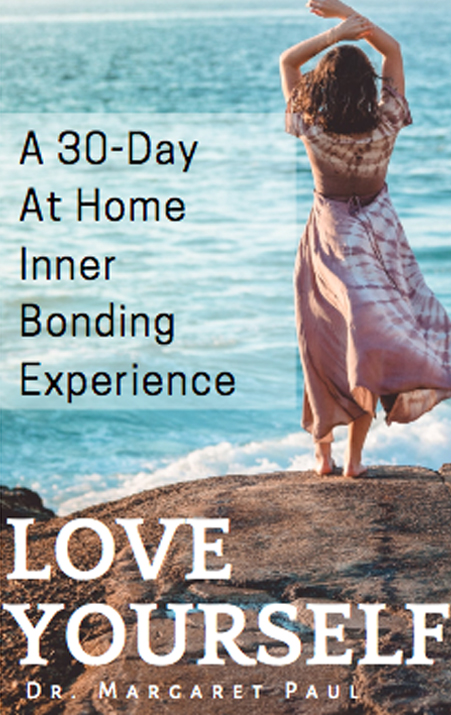
And this is why I created my Love Yourself 30-Day video course. If you’re looking to learn to love yourself, connect with your higher guidance, and become more aware of your intention, this course is for you. You can learn more in the description below.
When your intention is to learn to love yourself, this means you welcome your feelings rather than avoid them. It means you want to know how you are abandoning yourself, and what your inner child needs from you to feel loved and safe. It’s means you wants to know what’s true rather than continue to operate from false beliefs.
When we choose the intention to learn, we activate our loving adult. We become curious rather than harsh and judgmental. We are patient rather than demanding. We are more focused on truth rather than trying to control outcomes.
When your inner child feels that you are open to your feelings and to seeing who you truly are – not trying to fix or override your feelings, something wonderful happens. You relax and breathe deeply. Your inner child feels trusting that your adult will hear you, so you let your adult in on what’s really going on in the inner level, and this is where healing begins to occur.
In a session with Katie, she told me she felt tension in her chest, but when I asked her to go inside and ask her inner child what she was telling herself or how she was treating herself that was causing the tension, nothing emerged. Her inner child didn’t feel safe to let her in, not trusting that she would be heard and that her adult would take loving actions for her. So I asked Katie to open to bringing the love and compassion of her spiritual guidance into her heart, which she was able to do. She had a strong spiritual connection but had never used that to learn to be a loving adult with her inner child. After I asked her to be curious about what her inner child was trying to tell her, she heard, “You ignore and neglect me, just like mom and dad ignored and neglected me.”
“Wow!” Katie said. “I never realized that I’m treating myself the way my parents treated me. No wonder I feel alone and stressed so often.” Showing up as an open and curious loving adult is what gave her a connection with her inner child.
Our wounded self is programmed to treat ourselves the ways we were treated growing up, or the ways our parents or caregivers treated themselves. By learning and practicing Inner Bonding, you can discover the false beliefs that are causing you to abandon yourself.
However, you can believe you are doing Inner Bonding, but if you are doing it with an intent to control with an outcome in mind – other than to become a more loving human being, you will still be trying to control, and you won’t really be doing Inner Bonding.
You are doing Inner Bonding when are curious about your feelings – about what they are telling you regarding how you are treating yourself or about what’s happening with others and situations. You are doing Inner Bonding when you are present rather than in the past or future, which are the realms of the wounded self. You are doing Inner Bonding when you are open to learning with your higher guidance about truth and about what is loving to you, and you take loving actions on your own behalf and on behalf of others.
Your inner child doesn’t need you to be perfect. He or she needs you to be present, open, and curious, wanting to learn about your feelings rather than avoiding them or judging them.
Inner Bonding is a mind, body, spirit process, and your intention determines whether spirit can enter the process. The intention to control closes the door to your higher guidance, because connecting with your guidance is about your frequency, and the wounded self, coming from fear and false beliefs, has a very low frequency.
The intention to learn about love opens the door to spirit, because the intention to learn and love, along with putting clean food into your body, raises your frequency so that you can access your higher guidance.
I hope you can see how important it is when doing your inner work to be very honest with yourself about your intention. If you find that your intention is to control, instead of judging yourself for being in this intention, open to learning about the false beliefs that are leading you to try to control. When you become curious about the fears and false beliefs of your wounded self, rather than acting from them, you are then open to learning.
So today’s message is simple, but profound: The power of Inner Bonding lies in your intention. Not in doing it perfectly or fixing yourself or making your feeling disappear, but in choosing again and again to learn rather than control, and to love rather than judge, and to stay present rather than avoid, and to take responsibility rather than blame.
When your intention is aligned with love, Inner Bonding becomes a sacred process to connect with yourself and with spirit.
If today’s episode resonated with you and you’re ready to learn to shift your intention and learn to love yourself, I invite you to check out my 30-Day online video Course, “Love Yourself”. You’ll find the link in the description.
Thank you for joining me today and I’ll see you in the next episode.
I’m sending you my love and my blessings on your healing journey.