

Episode Summary:
Developing self-worth is an inside job – not something someone else’s approval can give to you. Others love can help you, but not until you are also loving yourself.
Transcription:
Hi everyone, and welcome to the Inner Bonding Podcast. I’m Dr. Margaret Paul and I’m so glad you’re here with me today. Today’s episode is about how learning to love yourself is what creates a deep sense of self-worth, and what loving yourself really means.
Many of us have been taught to believe that our worth is attached to external things, such as from achievement, approval, appearance, money, or status. We’ve been conditioned to think that if we can just do enough, prove enough, or please enough, we’ll finally feel worthy.
But that isn’t true self-worth. That’s conditional worth – and it always depends on something outside of us.
True self-worth can’t be given to you or taken from you. True self-worth comes from love – from the love you give to your inner child, your true soul self.
Today, we’re going to explore:
- The difference between false and true self-worth.
- How we lose touch with our inherent value.
- How to begin building genuine self-worth through loving yourself.
- And how the Inner Bonding process helps you anchor that love in your daily life.
Take a deep breath, and let’s begin this journey inward – a journey toward remembering that your worth has always been there, waiting for your love to awaken it.
Let’s begin with a simple question: What does it mean to feel worthy?
Many people think self-worth is the same as self-esteem. But there’s a difference. Self-esteem is often based on external things – what you achieve, how you look, how others see you. Self-worth, on the other hand, is an inner knowing of your intrinsic value – who you are as an individual spark of the Divine.
It’s the quiet, steady truth that says, “I matter. I am lovable. I am enough.”
But most of us didn’t grow up hearing that message. Maybe you grew up being praised when you did well and criticized when you didn’t.
Maybe you learned that love had to be earned – that your worth depended on being compliant, smart, attractive, athletic, or successful.
So you learned to look outside yourself for validation. And that’s where the false sense of worth begins.
Take a breath and ask yourself: Where have I been getting my sense of worth? Is it from others’ approval? From achievements? From relationships or appearance? Just notice – with compassion, not judgment.
When we depend on external sources, we live on a rollercoaster – up when people approve of us, down when they don’t. True self-worth is steady. It comes from learning to know who we are as a soul, which in Inner Bonding we call the inner child, and learning how to be a loving mom and dad to your inner child. The more you learn to be a loving adult to your inner child, the higher your sense of self-worth.
So how did we lose touch with our inherent worth?
When you were born, you were pure love – open, innocent, full of joy and curiosity. You didn’t have to do anything to be worthy. You simply were. Parents who wanted their baby don’t say that their baby isn’t worthy until he or she proves themselves. They see their baby as worthy just for existing.
But as you grew, you received messages that love and acceptance were conditional. You learned that being yourself wasn’t always safe.
Maybe you were told, “Be quiet.” “Don’t cry.” “You’re too sensitive.” “Be perfect.” Maybe you were compared to siblings or other children and told you weren’t good enough unless you were like them. Little by little, you learned to disconnect from your feelings and your true soul self that you were born as, in order to fit in, to survive, to be loved.
You built your wounded self – the part that tries to control and perform to get love. But that wounded self is built on a lie – the lie that you are not already enough.
False self-worth is an endless pursuit because it always depends on something outside of you.
You might think:
- If I’m successful, I’ll feel good about myself.
- If I look attractive, people will love me.
- If I find the right partner, I’ll finally feel worthy.
- If I have a child, then I will have worth.
- If I please everyone, I’ll be okay.
But these strategies never bring peace. They create exhaustion and anxiety, because they’re based on control and fear.
No amount of external approval or success can fill the emptiness that comes from self-abandonment.
When we abandon ourselves – by judging ourselves, ignoring our feelings, turning to addictions to numb our feelings, or making others responsible for our feelings and our sense of worth – we create inner emptiness and inner aloneness.
And then we try to fill that emptiness and aloneness through external things. But the emptiness can’t ever be filled by external things. It can’t be filled by food or alcohol, or by money, or by others’ approval or attention, or by sex, or by the myriad of other addictions available to us. The only thing that fills the emptiness is love – our love for our inner child – our true soul self.
Take a breath and ask yourself:
“What am I using right now to try to fill up and take away my emptiness and aloneness?” Is it someone’s approval? Productivity? Busyness? Appearance? Substances or other addictions? Just notice it, gently.
Healing happens when you begin to see that the child you once were, your soul – the one who was shamed, judged, or ignored – is still inside you, waiting to be seen by you, valued by you, and loved by you.
Close your eyes for a moment if you can. Picture yourself as a small child, maybe one or two years old. See your face, your eyes. See if you can see your inherent goodness, your inherent lovability. Does your inner child have to do anything to earn love, or can you see that you are lovable exactly as you are? What are the inherent qualities that make you you? How would you describe your little inner child?…Take a moment to notice some of your beautiful intrinsic qualities.
So how do we create true, lasting self-worth? We learn to love ourselves, but this isn’t always easy. When you grow up without love, how do you know how to love yourself?
Julie asked this question at one of my events:
“I’m finding it really hard to find worth in myself especially since I’ve never been worth anything to anyone. I was abused and fostered young. Then I had kids and they are now leaving, and I’m afraid they don’t love me because I’ve been so controlling. My husband left because I’m always fighting with him and always have a drama happening. I’ve got two of your books, Healing Your Aloneness and Inner Bonding, and I’ve done the free Inner Bonding course, but it’s so hard to find worthiness in me when I don’t have anyone around who values me. How do I learn to value me?”
And Rachael asked a similar question:
“How can I love myself if I was raised in a house where there was no love – where there was punishment and violence? How do I learn to love myself when I grew up in a loveless, abusive home? I don’t know unconditional love. I don’t know what love is.”
This is where learning and practicing Inner Bonding comes in, because a big part of the Inner Bonding process is learning to connect with a higher source of guidance – a source of guidance that does know what love is. A source of guidance that loves you and knows who you are in your soul. A source of guidance that becomes a role model for how to love yourself.
So what does it actually mean to love yourself? It doesn’t mean being selfish or arrogant. It means taking responsibility for your own feelings, needs, and well-being, just as you would take care of a small child if you wanted to be a loving parent.
It means listening to your inner child – that part of you who often communicates through feelings such as joy, sadness, fear, anxiety, depression, and so on – and responding with a compassionate intent to learn about how you might be treating yourself and what you might be telling yourself that may be causing painful feelings, instead of ignoring, judging, numbing with substances or processes, or blaming someone else.
When you learn to love yourself, you stop abandoning yourself. You stop judging yourself for being human. You stop expecting others to fill you.
And the miracle is that as you do this, your sense of worth begins to grow – naturally, steadily, quietly.
You start to feel peace inside, because you are finally giving yourself the love you’ve always needed.
Place your hand over your heart and take a deep breath. Ask your inner child, “What do you need from me right now to feel loved?” Maybe you need comfort, or rest, or reassurance, or play. Whatever comes, tell your inner child softly, “I’m here. I’m learning how to take care of you.” Practice staying present in your body with your feelings, just as you would with a baby who you love.
This is what creates self-worth – the consistent experience of being loved by you.
Let’s walk through how Inner Bonding specifically helps you build self-worth.
Step 1 is learning to be in your body with your feelings, so that you are aware the moment you feel empty or alone inside – or anything other than peace and fullness.
Notice when you feel anxious, empty, or inadequate. These feelings are signals that you’re abandoning yourself.
Step 2 is consciously choosing the intention to learn rather than the intention to control, avoid, or protect against pain – the only two choices of intention we have.
Ask, “Am I willing to learn how to love myself right now, rather than judge or avoid my feelings?” Invite the love, compassion, strength, wisdom, and courage of your higher self, your higher guidance, into your heart.
Step 3 is dialoguing with your inner child and your wounded self
Ask, “What am I telling you or how am I treating you that is causing painful feelings?” Listen gently. Then go deeper into your ego wounded self and ask this young or adolescent programmed aspect of you, “What are you trying to control, avoid, or protect against by abandoning the inner child?” Here is where you become aware of the false beliefs you absorbed as you were growing up that are causing you to abandon yourself and try to control others into loving you.
Step 4 is opening to your higher guidance
Turn inward and upward. Ask, “What’s the truth about me? What’s loving to me right now?” Spirit will always show you that you are worthy, whole, and lovable, and can role model loving actions.
In Step 5, you take the loving actions
Maybe you need to rest, speak kindly to yourself, eat well, express your truth, set a boundary, get exercise, or allow joy. Maybe you need to find a creative outlet, reach out to a friend, look for a different job, or get more training. Maybe you need to open to learning with a partner, friend, or relative.
Once you take the loving action, you go to
Step 6, evaluating the results
Notice how you feel after taking a loving action. Do you feel some relief? More peaceful? Lighter? That’s your confirmation that you’ve acted with love.
Every time you go through these steps, your self-worth deepens, because you’ve shown yourself that you matter.
Let’s do this together for a moment.
Take a slow breath.
Tune into your body. Notice any tightness or heaviness.
Ask your inner child, “What are you feeling?”
Listen. Maybe you feel fear, sadness, or loneliness.
Now ask spirit, “What’s the truth about me?”
Imagine hearing the words: “You are my beloved. You are enough. You are worthy.” Let that truth flow into your heart.
As you continue to love yourself, you’ll notice changes.
- You’ll stop tolerating unloving behavior from others.
- You’ll make choices that honor your feelings.
- You’ll speak your truth, even when it’s hard.
- You’ll feel freer, lighter, and more joyful.
When your worth comes from within, relationships become easier.
You no longer need to control others or seek their approval. You can share love, because you’re already full. There is a huge difference between getting love and sharing love. The wounded self is always trying to get love to feel worthy, but when you learn to love yourself, you feel inherently worthy and are filled up with love to share with those you love. Sharing love is the very best feeling in the world.
And this is the foundation of emotional freedom.
Ask yourself:
“How would my life change if I no longer needed anyone else’s approval to feel worthy?” Breathe and let that possibility expand inside you.
From a spiritual perspective, your worth has never been in question.
You are a spark of divine love – created from love, by love, for love.
Your soul is inherently worthy because it is part of spirit.
When you judge yourself, you block that truth. When you love yourself, you align with it.
Loving yourself is not about becoming worthy – it’s about remembering that you always have been worthy.
So let’s return to our central truth today: Loving yourself is what creates self-worth.
You cannot think your way into worth. You cannot earn it, achieve it, or get it from anyone else. You can only love yourself into it.
Every time you listen to your feelings, comfort your inner child, and act from love rather than fear, your self-worth grows stronger.
Take a deep breath.
Say quietly to yourself:
“I am lovable. I am enough. I am worthy of love because I am the light of love.”
Thank you for joining me today. May you walk forward knowing that your worth is not something to be proven – it’s something to be remembered, reclaimed, and lived.
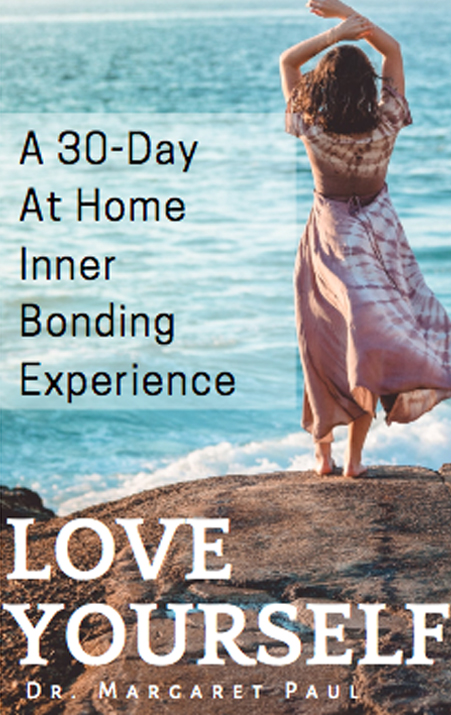
I invite you to join me for my 30-Day home study Course that teaches Inner Bonding: “Love Yourself: An Inner Bonding Experience to Heal Anxiety, Depression, Shame, Addictions and Relationships.”
As always, I’m sending you love and blessings on your healing journey.